There are taxi rides that look like taxi rides. And there are these.
A 72-year-old man, diagnosed with something serious. His wife had died two years earlier. His children lived in Lyon. He had to go to the Institut Paoli-Calmettes in Marseille for his first oncology consultation.
I picked him up one Tuesday morning in Gémenos. We didn't talk much on the way. When we arrived, he asked if he could call me when it was over, late afternoon. I said yes. He called me back at 4:30pm. I'd stayed reachable all day.
It's not always like that. Most medical rides are ordinary trips: a patient, an appointment, a return. But some aren't. And in those moments, being a driver also means being present without being intrusive, available without being heavy. That's what I want to talk about here.
When your relatives are far: the driver becomes a relay
The daughter of a patient called me from Paris one Tuesday morning. Her mother, 78, lived in Auriol. She had a cardiology appointment at Hôpital Sainte-Marguerite in Marseille on the Thursday. Impossible for the daughter to take the train for a two-hour consultation. Could I take care of it?
Yes. It's exactly the kind of service I provide, and it's increasingly requested. Families are geographically scattered, parents age in their town, children work at the other end of the country. When a serious medical appointment comes, organising transport from 800 km away is complicated.
In practice, I become the relay. I pick up the parent at home, accompany them to the surgery or hospital, stay available for the return, and can send the family a text confirming everything went well. Nothing extraordinary, but it's what's missing when you're far away.
Transporting an elderly person: what really changes
Driving an elderly person isn't driving fast and turning the meter. It requires patience for getting into the vehicle, fragile hips, knees that no longer bend as well, the handbag to be settled. A bad seating, and it's a whole day of pain afterwards.
I push the passenger seat forward as far as possible, tilt the backrest slightly, offer a hand to sit down, close the door calmly. On the road, I brake earlier, avoid the potholes in the districts I know. Small things, but they make all the difference for someone who leaves home once a week.
For isolated elderly people I systematically note the doctor's number and that of a relative. In case of a problem on the road, fainting, disorientation, loss of consciousness, I have a contact to call. It's not official protocol, it's common sense.
The Marseille hospitals I know by heart
For medical appointments in Marseille, the drop-off matters as much as the trip. Making a patient leaving chemo cross a car park under the August sun is adding an ordeal to their day. I know the discreet entrances, the outpatient zones, the ways to drop off on the shaded side.
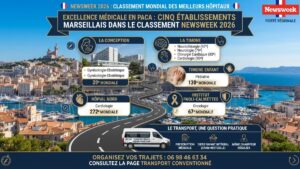
- Institut Paoli-Calmettes (boulevard Sainte-Marguerite, 9th), regional cancer centre. Drop-off right in front of oncology reception, direct lift to consultation floors.
- CHU Timone (5th, boulevard Jean Moulin), very busy main entrance. For cardiology, neurology or rehab consultations, I know the less congested side entrance.
- Hôpital Sainte-Marguerite (9th), cardiology building easily accessible from the rear outpatient zone, faster than the main entrance.
- Hôpital Nord (Saint-Jérôme, 13th), vast site, several pavilions. I go directly to the right building depending on the service, no need to search on arrival.
For other facilities in PACA, Aubagne, La Ciotat, Pays d'Aix, Salon, Toulon hospital centres, I also know the drop-off zones. Just specify the service when booking.
Long appointments: staying available
Some appointments take an hour. Others take a day, day-hospital chemotherapy, multidisciplinary consultation, full pre-op assessment. For those, I propose to stay available for the return rather than driving back empty at the end of the day.
In practice: I drop off in the morning, handle my rides in the sector, and come back as soon as the patient calls. It can take two hours or six. I manage my schedule accordingly, the patient doesn't have to worry about calling back in time, nor wait 40 minutes for a new taxi to arrive after a gruelling day.
Care homes and partner structures
I regularly transport care home residents for occasional outings, medical appointment, visit to a relative, administrative steps. Several structures in the region have me in their direct contacts: they know I'm reliable, punctual, and that I can adapt to a resident who needs time.
For care home directors and coordinators looking for a trusted carrier for their residents, don't hesitate to contact me. We can set up a simple arrangement: direct billing to the facility or family depending on your practices, transport planned in advance, and of course conventioned taxi when the appointment is medical.
CPAM coverage
Many families don't know that these trips are reimbursed. With a medical prescription from the GP or specialist, transport to a care facility is covered at 100% for a qualifying long-term illness (ALD exonérante) or a work accident, otherwise at 55% by French health insurance, the remainder possibly covered by the mutuelle depending on the policy (a consultation without an ALD is not covered). I advise you to call the health insurance office of your département to confirm.
The daughter of my Auriol patient saved the train ticket from Paris and the ride cost her mother nothing. That's exactly what the conventioned taxi is for.
For the full details of procedures, rates and covered centres, see our Medical transport guide.
Organising a first trip
Whether for an elderly parent, a loved one going through serious illness, or a care home resident, the best is to discuss it before you need it. Contact us specifying the situation, home, destination hospital, expected frequency. I'll tell you what we can set up, and what will be covered.
And if you call the same day for an emergency, I pick up too. MR Taxi remains reachable 24/7, that's also what accompanying someone vulnerable is about.